Why I Create Colorful Paintings as an Introvert Artist

People often expect artists to mirror themselves in their art. If you are quiet, they assume your work will whisper; if you carry a melancholic spirit, they imagine you will paint in shadows and muted tones.
I am an introvert. I live mostly inside myself, observing rather than speaking. I am deeply sensitive, often drawn toward reflection and silence. I wear black almost every day, not out of sadness but because it feels like home to me—a kind of soft armor in a noisy world.
You might think, then, that my paintings would be dark, moody, and somber. And yet, the opposite is true. My canvases are alive with color, overflowing with light, energy, and joy. People often tell me that my work makes them happy, that it lifts their spirits. And sometimes, I’m just as surprised as they are.
I don’t fully understand why I create in this way. Maybe it’s because painting is my release—where I pour out everything that feels heavy inside and transform it into something brighter. Or maybe it’s simply that color is my language, the one I can speak freely, even when my voice falters in the world.
For me, painting is not about explaining myself but about balancing myself. I live in quiet shadows, but on the canvas, I allow myself light. My art is the place where the part of me that longs for vibrancy, for joy, for connection, comes out and dances.
I paint because it is the truest way I know how to exist fully. It is where I let myself be more than my melancholy, more than my silence. It is where I remind myself—and hopefully others—that beauty, color, and joy can emerge even from the quietest, darkest places.
E.
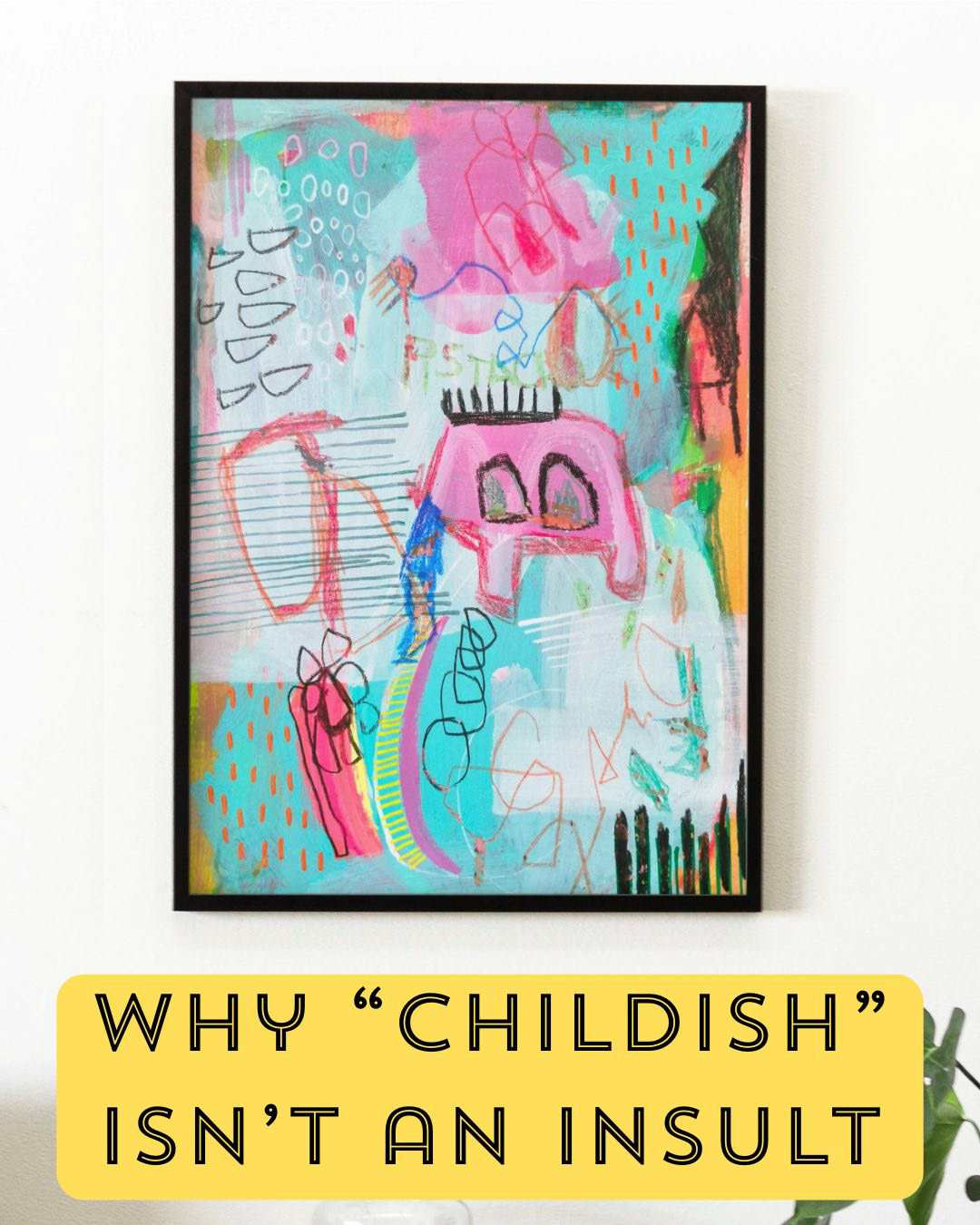
"Your work looks childish"
I've hear that many times, but I've never really taken it as an insult. If anything, I think it points to something that's actually quite rare.
Because when I think about it, children create in a way most adults simply can’t anymore. There’s a quote by Jean-Michel Basquiat that deeply resonates with me: “I want to make paintings that look as if they were made by a child.”
Not because children lack skill—but because they create with a kind of freedom that’s incredibly hard to reclaim. Children draw and paint freely. They just express who they are, as they are, in that moment. There’s no filter. And that’s exactly what makes their work feel so alive.
Creating without fear of judgment—real or imagined—is difficult once you’re used to being evaluated.
It requires letting go of control. Letting go of the need to justify what you’re doing.
Letting go of the idea that the result has to prove something. That’s not natural anymore. It’s a choice.
When I create, I’m not trying to imitate a child’s style.
I’m trying to access that same freedom.
To make something honest without overthinking it.
To let instinct lead instead of constantly correcting it.
To express something real without worrying about how it will be received.
That’s why words like primal, intuitive, and unrestricted feel more accurate to me than “childish.”
Maybe the reason people call this kind of work childish is because it reminds them of something they’ve lost.
Not skill—but openness.
Not ability—but permission.
So when I hear that word, I don’t hear a lack of maturity. I hear this: "This feels free in a way I’m not used to anymore."
And to me, that’s exactly the point.
E.